California’s housing landscape can change within a few miles. A compact home may need to fit into a crowded Los Angeles neighbourhood, while another must withstand mountain snow, desert heat or wildfire exposure. Modular construction offers an appealing alternative by moving much of the building work into a controlled factory environment before the home is transported and completed on the property.
Interest in factory-built housing has grown as California looks for faster and more predictable ways to deliver new homes. State lawmakers introduced a housing innovation package in March 2026 aimed partly at reducing barriers faced by modular and other off-site construction methods. However, zoning, financing, transportation, labour rules and site preparation can still affect whether a project saves time or money.
The word “modular” is frequently used as a broad term for factory-built housing. This ranking therefore includes companies offering true volumetric modular homes as well as established panelized-home systems. The construction method used by each company is clearly explained so that buyers can compare them correctly.
1. Dvele – Best Overall Modular Home Company
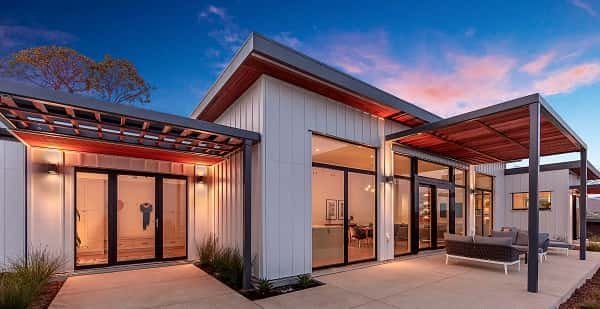
Dvele combines modern modular construction with energy efficiency, climate resilience and advanced home-monitoring technology.
Dvele takes first place for California buyers seeking a premium modular home with a strong focus on performance. Its homes are built in factory-produced modules using advanced materials and are designed to provide better energy control, indoor comfort and resistance to challenging environmental conditions.
Customers can begin with an existing floor plan and select coordinated interior and exterior design packages. Dvele also offers its Self-Powered home option, which can combine solar generation, battery storage and energy-management features. Its DveleIQ system monitors factors such as indoor air quality, humidity, water usage, energy consumption and volatile organic compounds.
The company reports delivering more than 270 modules and features completed projects in California, including homes in Sonoma. Dvele is particularly suitable for buyers who want a contemporary design and are willing to invest in energy systems and long-term building performance.
Headquarters: 3223 S. Crismon Road, Mesa, AZ 85212. The company accepts project enquiries for California locations.
2. Champion Homes – Best for Selection and Dealer Reach
Champion Homes is a practical choice for buyers who want access to numerous floor plans, regional retailers and an experienced national manufacturer.
Champion produces modular homes, manufactured homes, accessory dwelling units and other factory-built housing products through a large family of regional brands. Buyers can explore traditional, farmhouse, contemporary and family-oriented layouts through authorised retailers serving their area.
The company says its brand network has produced more than three million factory-built homes and includes over 24 housing brands. This scale gives buyers access to a wider range of layouts and price categories than many smaller modular manufacturers.
Champion’s California presence is strengthened by Silvercrest, a company brand founded in Corona in 1969. Silvercrest homes are available through more than 70 retailers and land-lease communities serving areas from Sacramento to Chula Vista. Because Champion sells different types of factory-built housing, customers should confirm whether a particular model is constructed as a state-code modular home or a federally regulated manufactured home.
California brand base: Silvercrest Homes, Corona, California.
3. Cavco Homes – Best for Affordable Customisation
Cavco provides a useful balance of attainable floor plans, upgrade choices and higher-end designs that resemble conventional site-built homes.
Cavco offers modular and manufactured homes through a national dealer network. Its housing collections cover several market levels. The Halo and Banner series focus on attainable everyday living, while the Ovation and Reserve collections provide more space, upgraded finishes and greater customisation.
Modular buyers can select layouts with open living areas, kitchen islands, multiple bedrooms, home offices and energy-saving features. The homes are constructed inside protected factory facilities, helping reduce exposure to rain and other weather-related interruptions during the main production stage.
Cavco also received two national design awards from the Manufactured Housing Institute in 2026. Its broad product range makes it suitable for buyers who want to compare entry-level and premium designs through the same company. Availability, engineering requirements and permitted models depend on the California dealer and project location.
Corporate office: 3636 N. Central Avenue, Suite 1200, Phoenix, AZ 85012-1998.
4. Pacific Modern Homes – Best California-Based Panelized Home Company
Pacific Modern Homes is well suited to owner-builders and customers who want an engineered home package that can be completed by a local contractor.
Pacific Modern Homes, commonly known as PMHI, is based in California and specialises in panelized kit homes rather than fully finished volumetric modules. The company manufactures numbered, pre-framed wall panels and supplies engineered roof trusses, sheathing and other structural components for assembly at the property.
Customers can choose from pre-engineered designs or work with the company on modifications. Its catalogue covers compact cottages, ranch homes, two-storey residences, garages and accessory buildings. Factory-installed windows and prepared wall sections can reduce some of the measuring, cutting and framing work normally completed at the construction site.
PMHI is a strong option for people who already have a trusted California general contractor or who want more control over local labour and finishing materials. Buyers must still arrange the foundation, utilities, permits, on-site assembly and most interior completion work.
Mailing address: P.O. Box 670, Elk Grove, CA 95759.
5. Lindal Homes – Best for Architect-Designed Custom Homes
Lindal Homes stands out for premium post-and-beam architecture, large windows and designs created for distinctive or scenic properties.
Lindal supplies engineered home packages rather than complete volumetric modular units. Its structural components are prepared off-site and delivered for construction by a local builder. The company offers modern homes, traditional residences, small homes and designs inspired by the architectural principles of Frank Lloyd Wright.
Operating since 1945, Lindal says it has supplied more than 50,000 homes. Its system is especially attractive for buyers who want extensive glass, open interior spaces, exposed structural elements or a design adapted to mountain, forest or coastal surroundings. The company also promotes a lifetime structural warranty for qualifying homes.
California customers can work through local Lindal dealers for site evaluation, design development, budgeting and package delivery. Construction labour, foundations, mechanical systems and local permits are generally handled separately.
Corporate address: 6840 Fort Dent Way, Suite 220, Seattle, WA 98188.
How to Choose the Right Modular Home Company
Start by identifying the exact construction system being offered. A volumetric modular home arrives in large completed sections, while a panelized company supplies wall, roof and structural components for assembly by a contractor. Manufactured homes follow a separate federal building standard and may have different financing, installation and property-classification requirements.
Request a complete project estimate rather than comparing advertised home or kit prices. The final budget may include:
- Land and surveying
- Architectural and engineering work
- Grading and foundation construction
- Utility connections and septic systems
- Local permits and development fees
- Factory transportation
- Crane and module installation
- Garage, decks and landscaping
- Local contractor labour and interior finishing
The agreement should clearly identify who is responsible for permits, site engineering, factory production, transportation, installation and warranty service. Buyers should also consider milestone-based payments, proof of insurance and contractual protection if production is delayed or the manufacturer becomes unable to complete the home. The closure of previously promoted California modular businesses demonstrates why financial stability and contract safeguards deserve careful attention.
FAQs
Q: Do I need to purchase land before contacting a modular home company?
A: You can speak with companies and review floor plans before buying land. However, dependable pricing usually requires a specific property. The company must examine zoning, setbacks, road access, slope, soil conditions, utility availability and any wildfire or environmental restrictions before confirming whether a design can be built there.
Q: Can a modular home be constructed on a sloped California property?
A: It may be possible, but the property will normally require additional engineering, grading and foundation work. Limited road access can also create difficulties for trucks, cranes and large factory-built modules. A panelized system may sometimes be easier to deliver to a restricted or steep site, although the best method depends on an engineering study.
Q: What happens if a modular home company closes before delivering the house?
A: The result depends on the contract and how payments were handled. Buyers should avoid paying most of the price too early. The agreement should explain ownership of completed materials, refund rights, payment milestones and what happens if the manufacturer fails to perform. A construction lender and California real-estate attorney can review these protections before a large deposit is made.
Q: Can a homeowners association refuse a modular home?
A: An HOA may enforce lawful architectural standards concerning exterior materials, roof design, size, colour and placement. Buyers should review the community’s covenants and obtain written architectural approval before ordering the home. A modular home’s compliance with state or local building codes does not automatically override private community design rules.