No, SBRs (short-barreled rifles) are not legal to possess, own, manufacture, or import in California, unless a person falls within extremely narrow law-enforcement or federally licensed exceptions. Many gun owners relocating from other states assume they can bring their registered SBR with them, while newer firearm enthusiasts believe they can simply buy a rifle and shorten the barrel with a tax stamp, just like in other states under federal NFA rules. The truth is more restrictive. California does not follow the same National Firearms Act exemption that allows civilian ownership with a federal tax stamp. Any rifle configured with a barrel shorter than 16 inches or an overall length shorter than 26 inches becomes a prohibited weapon under state law, even if the owner registered it federally. The moment a lawful rifle becomes an SBR within California, it turns into a felony-level offense. California does not just regulate SBRs; it bans them outright for almost everyone.
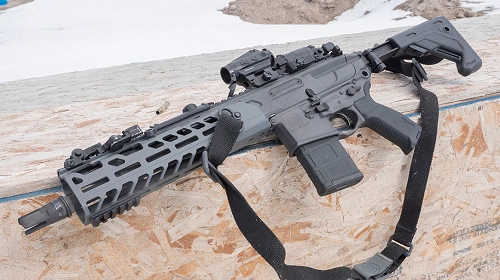
How California Defines a Short-Barreled Rifle
California Penal Code § 17170 defines a short-barreled rifle as any of the following:
- A rifle with a barrel less than 16 inches
- A rifle with an overall length under 26 inches
- A rifle modified to become concealable or shortened
- A firearm made from a rifle that meets any of the above measurements
This means that even altering a rifle to become concealable, folding or collapsing a stock to reduce overall length, or attaching certain accessories can put a gun into SBR status. California law looks at capability, not just configuration. If a weapon can be readily fired in an illegal configuration, the state may treat it as an SBR even if the stock can be extended or modified.
Why Federal Tax Stamps Do Not Legalize SBRs in California
In most states, the federal NFA (National Firearms Act) allows civilians to own SBRs by submitting ATF Form 1 or Form 4 paperwork, along with a tax stamp. California does not accept this system for the general public. Even if the ATF approves a Form 1 or Form 4, and even if a rifle is legally registered under federal law, California still bans its possession under state law.
A federally registered SBR becomes contraband the moment it enters California, regardless of paperwork. Federal approval does not override California Penal Code § 33215, which makes possession, manufacture, or transport of SBRs a crime. The state’s position is simple: California law controls firearms inside its borders, and federal registration never grants permission to violate state prohibitions.
Professional and Law-Enforcement Exceptions
There are very limited exceptions in California for:
- Police agencies and SWAT units
- Federal firearms licensees (FFLs) with special occupational tax (SOT) status
- Certain defense contractors and manufacturers
- Crime labs and forensic facilities
Even these groups must follow tight acquisition, storage, and transport rules. Individual officers do not personally own SBRs; their agency owns and controls them. Civilian ownership through law-enforcement employment is not allowed.
Can You Convert a Pistol Into an SBR?
No. Attaching a shoulder stock, extending a brace, or installing a rifle-style upper on certain pistols can transform a legal pistol into an illegal SBR. The moment a pistol becomes designed to fire from the shoulder with a barrel under 16 inches, it violates state law. Californians sometimes misunderstand federal brace rulings or ATF updates and believe pistols with braces are SBR-equivalents. Although California has its own rules regarding pistol braces, turning any firearm into a shoulder-fired weapon with a short barrel is treated as manufacturing an SBR—an illegal act.
Penalties for Illegal SBR Possession
Possessing an SBR in California can lead to:
- Felony charges
- Firearm seizure and forfeiture
- Loss of future gun rights
- Potential jail or prison time
Even if someone owns the weapon legally in another state, merely transporting it into California can lead to criminal liability. Federal registration does not protect the owner from state prosecution.
Legal Alternatives to SBRs in California
Some firearm owners choose “featureless rifles,” compliant PCCs, or pistols with arm braces that meet state length standards, but these too must be configured carefully. Rifles must maintain both the 16-inch barrel and the 26-inch minimum overall length, measured with the stock fully extended. Using pinned extended barrels or fixed stocks can help maintain legality, but they must be permanently compliant.
Conclusion
Short-barreled rifles are illegal in California, regardless of federal tax stamps, ATF registration, or lawful ownership in another state. California bans the possession, manufacture, and importation of SBRs for civilians, while only rare institutional exceptions exist for law-enforcement and licensed defense professionals. In California, the key rule is clear and uncompromising: if a rifle’s barrel or overall length is too short, it is prohibited. Responsible gun owners must avoid SBR configurations entirely to stay within state law.