Yes, Surrons can be legal in California, but only if they meet motorcycle or electric bicycle requirements. Many riders buy a Sur-Ron thinking it is just an electric dirt bike that can be ridden like a bicycle anywhere. Others believe that because it has no gas engine, it’s exempt from DMV rules. The truth is more complicated. A Sur-Ron is not automatically street legal the moment you buy it, and in many cases, riding one on public roads without registration is illegal.
California treats the Sur-Ron differently depending on how fast it can go, whether it has required equipment, and how it is used. A Sur-Ron can be a legal street motorcycle, an off-road dirt bike, or a completely illegal vehicle depending entirely on how it is set up and where it is ridden.
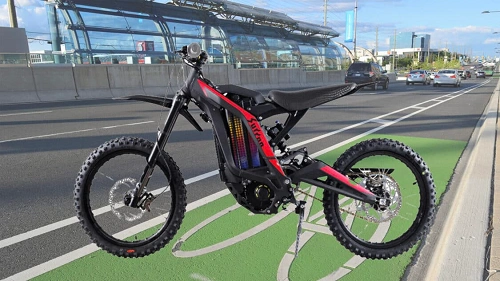
How California Classifies the Sur-Ron
California law does not classify Sur-Ron bikes as bicycles by default. They are usually treated as electric motorcycles or off-highway vehicles (OHVs) because they:
- Have powerful electric motors
- Can exceed the 20–28 mph e-bike speed limit
- Are throttle-based, not pedal-assist (on most models)
Without pedals, the Sur-Ron cannot qualify as a Class 1, 2, or 3 e-bike under California Vehicle Code. That means it cannot legally be ridden in bike lanes, on shared paths, or on roads where bicycles are permitted unless it meets motorcycle standards. Most Sur-Ron models out of the box fall under motor-driven cycles, which require DMV registration, a motorcycle license (M1 endorsement), and insurance to ride legally on public streets.
Can a Sur-Ron Be Street Legal?
A Sur-Ron can only be street legal if it is modified and registered as a motorcycle. To qualify, it must have:
- DOT-approved headlights, brake lights, and turn signals
- A rearview mirror
- Street-legal tires
- A horn
- A motorcycle VIN that California accepts
- Insurance and DMV registration
Some Sur-Ron models do not come with VIN numbers that California will register, meaning they can never be made street legal no matter how many parts you install. Riders must check whether their specific model has an acceptable VIN before trying to register it.
After modifications, the owner must complete registration at the DMV and show proof of equipment and insurance. Riding an unregistered Sur-Ron on the street—even after upgrading it—remains illegal without official registration.
Off-Road Use: When You Don’t Need Registration
Many Sur-Ron owners use their bikes only on trails, dirt tracks, private land, or off-highway vehicle parks. In these cases, the Sur-Ron is treated as an Off-Highway Vehicle (OHV). Off-road use still requires a Green Sticker (or Red Sticker if it’s not emissions-certified) issued by the California DMV. Riders must use designated OHV areas, follow trail rules, and wear helmets. Riding on public roads to “connect trails” without registration remains illegal, even for off-road bikes.
Where You Cannot Ride a Sur-Ron
Even though it is electric, a Sur-Ron cannot legally be ridden:
- On public roads without registration
- In bicycle lanes without e-bike classification
- On sidewalks
- Through parks, beaches, or pedestrian paths (unless posted as OHV legal)
- On public land not designated for OHV use
Electric power does not make a vehicle exempt from road laws. If a Sur-Ron can reach motorcycle speeds, California treats it as a motorcycle, not a bicycle.
Does a Sur-Ron Require a Motorcycle License?
If a Sur-Ron is street legal and registered, the rider must have:
- A valid driver’s license with an M1 motorcycle endorsement
- Insurance coverage
- A DOT-approved helmet
For off-road riders on public trails, helmets are required regardless of age. A license is not required for off-road use only, but the bike must still be properly registered for off-road operation.
Penalties for Riding a Sur-Ron Illegally
Operating an unregistered Sur-Ron on public streets can lead to:
- Fines for riding an unregistered vehicle
- Tickets for no insurance
- Impoundment of the bike
- Charges for driving without a motorcycle license (if applicable)
- Additional citations if the bike lacks safety equipment
These penalties add up quickly and can cost more than properly registering the bike.
Conclusion
Surrons are legal in California, but only when matched to the correct legal category. They are not legally treated as bicycles unless heavily modified and legally classified—which most are not. Riders can operate them legally as either DMV-registered street motorcycles or as Green-Sticker OHV dirt bikes. Electric power does not give riders a free pass on public roads. In California, a Sur-Ron becomes legal only when the owner follows the rules: proper classification, proper equipment, and proper registration. The bike isn’t illegal by nature—but the way it’s ridden can be.