If you’ve ever bought electronics, furniture, food packaging, or even walked into a parking garage in California, you’ve seen it —
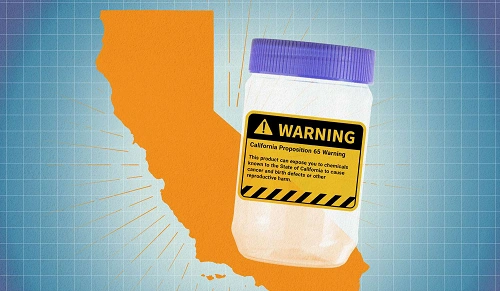
“WARNING: This product contains chemicals known to the State of California to cause cancer or reproductive harm.”
It’s on coffee cups. It’s on hotel doors. It’s on cables, backpacks, appliances, and sometimes even on buildings themselves.
For people visiting from other states, it feels bizarre. Why does California plaster these warnings everywhere? And if these products are so dangerous, why don’t other states do the same?
The truth is, the P65 warning isn’t about sudden new dangers. It’s about how California chose to regulate consumer risk — aggressively, broadly, and publicly — decades ago. What you’re seeing today is the outcome of a law passed in the 1980s colliding with modern manufacturing, global supply chains, and legal liability.
California didn’t invent toxic chemicals.
It invented a system that forces companies to talk about them.
Here’s how that happened.
It Comes From a Voter-Approved Law With Teeth
Back in 1986, California voters passed a sweeping public health law designed to protect residents from exposure to chemicals linked to cancer and reproductive harm.
Instead of banning every risky substance outright, the law took a different approach:
If a product exposes people to listed chemicals above very low thresholds, companies must provide a clear warning.
No warning?
The business can be sued — not just by the state, but by private citizens and advocacy groups.
That enforcement structure matters. It created a powerful incentive for companies to warn first and argue later.
Over time, that incentive reshaped how products are labeled nationwide.
California Uses Extremely Low Safety Thresholds
Another key reason you see P65 warnings everywhere is how conservative California’s exposure limits are.
The state sets warning thresholds far below what many federal agencies consider dangerous. In some cases, the limits are hundreds or thousands of times lower than levels shown to cause harm in studies.
That means trace amounts — tiny residues from plastics, inks, adhesives, or metal components — can trigger a warning requirement.
So even if a product poses little real-world risk, it may still legally require a label in California.
Manufacturers face a choice:
- Redesign the product (expensive)
- Perform complex exposure testing (expensive)
- Or slap on a warning (cheap)
Most choose the warning.
Lawsuits Drive Over-Labeling
Here’s the part many people don’t realize.
California allows private lawsuits to enforce this law. That means law firms and advocacy groups can sue businesses directly for missing warnings — and collect legal fees if they win or settle.
Because defending these cases is costly, many companies add warnings proactively, even when risk is minimal.
It’s legal self-defense.
As a result, labels appear on everything from power cords to hotel lobbies. The system rewards caution — not precision.
Companies Don’t Want Separate Packaging for One State
Manufacturers sell products nationwide.
Creating California-only packaging is expensive and complicated. So instead of producing two versions, many brands simply add the P65 warning to everything they ship in the U.S.
That’s why people outside California sometimes see the same labels online or on imported goods.
The warning may be required only in California — but it spreads everywhere for logistical reasons.
California Chose Disclosure Over Prohibition
Unlike some countries that ban certain chemicals outright, California leaned heavily on transparency.
The idea was simple: give consumers information and let them decide.
Rather than saying “you can’t sell this,” the state said:
“If you sell it, you must disclose potential risks.”
That philosophy produced a marketplace flooded with warnings — but also gave consumers more visibility into chemical exposure than anywhere else in America.
Whether that visibility actually helps people make better decisions is still debated.
The List Keeps Growing
California maintains an official list of chemicals covered by the law, and new substances are added regularly as scientific evidence evolves.
Today, hundreds of chemicals are included — everything from lead and formaldehyde to compounds created during cooking or manufacturing.
As the list expands, more products fall under warning requirements.
That’s why P65 feels unavoidable.
Critics Say the Warnings Have Lost Meaning
Here’s the unintended consequence.
When everything carries a warning, people stop paying attention.
Many public health experts argue that P65 labels no longer communicate real risk effectively. Instead of highlighting truly dangerous exposures, the warnings blend together into background noise.
You don’t learn how much exposure exists.
You don’t learn how risky it actually is.
You just see another sign.
Supporters say the system still pressures companies to reduce toxic materials. Critics say it overwhelms consumers with vague alerts.
Both can be true.
Other States Chose Different Paths
Other states rely more on federal standards or targeted chemical bans. They don’t use California’s broad, lawsuit-driven disclosure model.
That’s why you don’t see equivalent warnings nationwide.
California simply went further — and built enforcement into the law itself.
The Bottom Line
The P65 warning exists only in California because California passed a unique voter-approved law that forces companies to disclose even tiny chemical exposures — backed by strict thresholds and aggressive enforcement.
It’s not that California products are more dangerous.
It’s that California demands more disclosure.
What started as a public health effort has evolved into a legal and logistical system where warnings are often the easiest solution — even when actual risk is low.
So when you see that familiar label, remember:
It doesn’t always mean something is unsafe.
It means California made companies tell you — just in case.