Black ice doesn’t check license plates. A car that loses grip on the climb toward Donner Summit behaves about the same as one that lets go on a Minnesota interstate in February, which is to say it goes where it wants and often takes a few neighbors along. The pavement physics travel well. The insurance rules do not.
Drivers who know the Sierra corridors learn to read them. Chain controls appear with almost no warning, and spin-outs on I-80 near Truckee or along US-50 into South Lake Tahoe can close lanes for hours. Minnesota has its own version during freeze-thaw swings, when daytime melt refreezes overnight and a lane that looks perfectly clear is anything but. Same hazard, more or less. Very different path to recovery once the injuries are real.
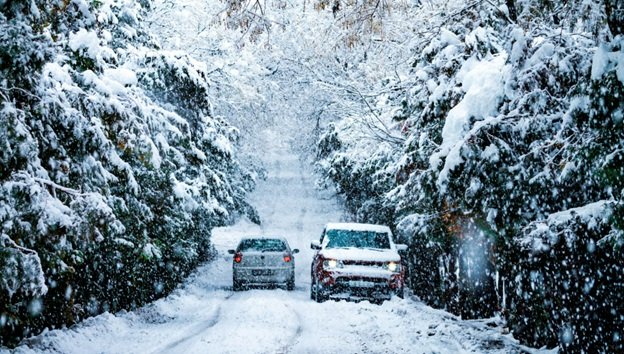
Snow and Ice Risks Shared Coast to Coast
Winter pavement is depressingly consistent in what it does to a moving vehicle. The Federal Highway Administration’s Snow & Ice resource, maintained under its Road Weather Management Program, reports that 24 percent of weather-related crashes happen on snowy, slushy or icy surfaces, with another 15 percent occurring while snow or sleet is actually falling. Translated into people, that means roughly 1,300 deaths and more than 116,800 injuries a year on frozen pavement, plus close to 900 additional fatalities and nearly 76,000 injuries during active snowfall.
Federal data for 2023, compiled through the Fatality Analysis Reporting System and the Crash Report Sampling System and published in the National Highway Traffic Safety Administration’s Traffic Safety Facts series, tracks the same trend. About 101,390 police-reported crashes happened under snow or sleet conditions. Of those, 320 were fatal and an estimated 22,293 caused injuries.
Whether the ice forms at 7,000 feet or on a flat Minnesota highway, traction vanishes and stopping distances stretch. What differs is what happens after the tow trucks leave and the first bill arrives.
Minnesota’s No-Fault Gate for Full Recovery
Minnesota starts with first-party Personal Injury Protection. Your own policy pays, regardless of who caused the wreck.
The consumer guide Auto Insurance Basics, published by the Minnesota Department of Commerce, sets the floor at $40,000 in benefits, split evenly between medical expenses and non-medical economic losses such as wage replacement. Claims generally must be filed within six months, which arrives faster than people expect while they are still juggling appointments and body shop estimates.
That structure gets treatment moving early, and on that score it works. What it does not do is make an injured person whole. Nothing in the PIP layer compensates pain, lost sleep, or the months of being unable to lift a child or a ladder. Reaching those damages requires clearing a statutory bar first, then moving against the at-fault driver’s liability coverage.
When a winter crash lands near that line, the medical chart is the whole ballgame, which is why claimants often bring in counsel such as the attorneys at Milavetz Law to measure the records against the statute rather than assume the threshold has been met.
Exact Thresholds That Unlock Recovery
Minnesota Statutes section 65B.51 spells out the conditions. Noneconomic damages become available only if one of these is satisfied:
- The calculated sum of reasonable medical expense benefits (paid or payable), the value of free care provided by household members, and certain adjustments exceeds $4,000, after subtracting qualifying diagnostic and rehabilitation amounts
- The injury results in permanent disfigurement, permanent injury, death, or disability lasting 60 days or more
Disability carries a specific meaning here. It means being unable to engage in substantially all of the injured person’s usual and customary daily activities. Not “uncomfortable.” Not “working through it.”
A strained neck that settles down after five weeks of therapy will likely stay inside pure no-fault territory. A fractured wrist needing hardware, a concussion that keeps someone off work for two months, or any impairment a physician calls permanent usually clears the gate. Icy-road pileups have a habit of producing that second category, largely because of secondary impacts nobody sees coming.
California’s Pure At-Fault Approach on Mountain Roads
California never adopted no-fault, and it applies pure comparative fault. On that same white-knuckle stretch of I-80, the analysis runs through ordinary negligence. No dollar threshold, no 60-day clock. Pain and suffering damages sit on the table from the start, assuming liability can be proven.
Proving it is the work. Did the other driver slow for conditions that were plainly visible? Were the tires bald? Was the following distance sane on a road that had already claimed two cars that morning? Those questions get argued with photographs, dash footage and Caltrans condition reports rather than billing summaries.
So one physical event follows two tracks depending on where it happened. Does that difference change how carefully the first week gets documented? Not really, because thin records sink otherwise solid claims in both systems.
Documentation That Decides Both Systems
Whichever rules apply, the medical file tends to write the ending. Treatment dates. Work restrictions in writing. Specific notes about what the person can no longer do at home, not just vague references to soreness. Continuity of care, too, without a three-week gap where the patient decided to tough it out.
Fee structures matter as well. Earlier coverage of slip-and-fall lawyer costs in California noted that contingency arrangements let injured people pursue medical bills and non-economic damages with nothing upfront, and that logic carries over cleanly to threshold fights elsewhere.
The physical risk on Tahoe’s approaches and Minnesota’s interstates lines up almost exactly. The legal frameworks do not line up at all. For anyone whose injuries sit near the $4,000 or 60-day markers after a winter crash, an early review by counsel who knows the governing state’s rules remains the most sensible next move.