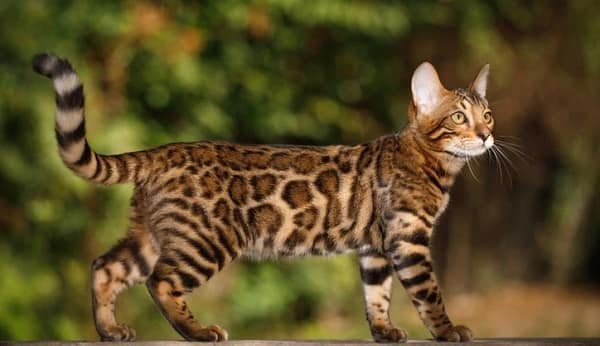
Yes, Bengal cats are legal in California, but the laws are not as simple as people assume. Many believe the state requires Bengals to be F5 or later, while others think early-generation Bengals are banned entirely. The truth is more nuanced. California regulates “restricted species” under state wildlife rules, and the Asian leopard cat — the wild ancestor of Bengals — is not listed as a restricted species under California Code of Regulations, Title 14, § 671. Because of that omission, the state does not impose a clear generation-based ban on Bengal cats. Most breeders and municipalities still prefer or recommend Bengals that are F4 or F5 and later, but this preference is not a strict statewide law. In other words, California considers Bengal cats legal, but the exact generation requirement is more about interpretation and local rules than state-level bans.
California’s Law Does Not Explicitly Ban Bengal Cats by Generation
The most important point is simple: the California restricted-species list does not name the Asian leopard cat. Since the law bans only the animals listed under § 671(c), and Bengals are not on that list, Bengal cats are generally allowed across the state. This is different from what some people believe. There is no statewide rule saying “F5 only” or “F4 required” written into the law. Instead, the law focuses on specific exotic species, not hybrid generations. Because Bengals are a hybrid of a non-listed species and domestic cats, California treats them as domestic animals unless a local city or county adds additional restrictions.
Why the F4 vs. F5 Confusion Exists
Bengal breeders, animal shelters, and hybrid-cat communities often mention that Bengals should be F4 or F5 to be considered fully domesticated. This idea comes from behavior, predictability, and international standards, not from California’s state law. F1 through F3 Bengals tend to show stronger wild traits, so many breeders avoid selling them to everyday households. As a result, people assume the law requires F5. In reality, F5 is simply the safest and most universally accepted level — but not a statewide legal requirement. Many municipalities and private housing rules prefer F4 or later, which creates even more confusion. The difference comes from policy, not from California wildlife regulations.
Local Ordinances and Housing Rules Can Add Restrictions
Even though the state does not explicitly ban early-generation Bengals, some cities or counties may impose their own exotic-pet regulations. These rules can set requirements about hybrid animals, and early-generation Bengals may fall under those local definitions. Landlords, HOAs, and apartment complexes may also set their own rules to avoid behavioral issues. Because of these local restrictions, many Bengal owners stick to F4 or F5 cats, even though state law itself does not mandate a specific generation. California allows local governments to control exotic or hybrid species within their borders, so Bengal owners should check their local rules before adopting.
Buying and Owning a Bengal Cat in California
You can legally own, adopt, breed, or buy a Bengal cat in California as long as it is treated as a domestic cat. Reputable breeders routinely provide pedigree papers showing an F4, F5, or later generation. These papers matter mainly for clarity and to meet the expectations of landlords or city regulations. For pet owners, the process is simple: Bengals do not require special wildlife permits, do not need exotic-animal registration, and are not regulated as restricted species by the state. Most adoption centers and veterinarians across California treat Bengals like any other cat.
Importing a Bengal Cat Into California
Since the Asian leopard cat is not listed as restricted, California does not stop owners from bringing Bengal cats into the state — regardless of generation. The only exceptions happen when a city or county has its own ordinance that treats early-generation hybrids differently. Anyone moving into California should check both state and local rules, but at the state level, Bengal cats are legal without needing exotic-animal permits or registration.
Why Most People Prefer Higher-Generation Bengals
Even though early-generation Bengals (F1–F3) are not explicitly illegal statewide, most owners and breeders avoid them because they show stronger wild instincts. F4 and F5 Bengals behave more consistently like domestic cats. They are easier to train, socialize, and integrate into households with children or other pets. That is why breeders almost always offer F5 or later — not because California demands it, but because the cats fit better into typical homes and avoid unpredictable behavior.
Conclusion
In 2026, Bengal cats are legal in California, and the law does not impose a strict generation requirement. The Asian leopard cat is not listed under the state’s restricted-species rules, so Bengals — regardless of generation — are considered legal domesticated hybrids at the state level. The popular belief that only F5 Bengals are allowed comes from breeder standards and local preferences, not from statewide law. California’s approach is simple: since Bengals are not on the restricted-species list, they are legal domestic cats. Owners only need to check local city or county rules and follow normal pet-ownership guidelines.