No, FRT triggers are not legal in California, and the state treats them as fully prohibited firearm accessories regardless of changing federal rules or how other states handle them. Many gun owners hear about federal settlements, ATF updates, and national debates and assume that FRT triggers might now fall into a gray area. But in California, there is no gray area at all. The state considers any device that speeds up a semi-automatic firearm — whether it’s a bump stock, trigger crank, or forced-reset mechanism — to be a banned “multiburst trigger activator.” This classification is broad on purpose, and it applies the moment the device enters California. Even if the trigger fires one shot per pull in a technical sense, California does not focus on the mechanics. It focuses on the practical rate of fire. If a part lets a gun shoot far faster than normal, the state bans it without exception. That’s why FRT triggers are treated as contraband in California in 2026.
How California Classifies an FRT
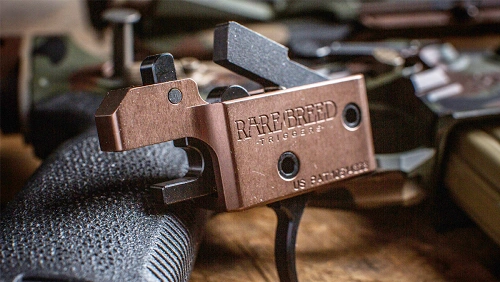
California Penal Code section 16930 defines a multiburst trigger activator as any device that increases the rate of fire of a semi-automatic weapon. Forced-reset triggers fit directly into that definition because they mechanically push the trigger forward after each shot, allowing extremely fast follow-up shots. Even though the shooter still technically “pulls” the trigger, the mechanical reset creates a firing rhythm that closely resembles other rapid-fire mechanisms. California does not accept arguments about technical compliance or semi-automatic definitions. Under state law, the effect is what matters: a faster-than-normal firing cycle. That’s enough to classify an FRT as a prohibited trigger device.
Why California Keeps FRTs Illegal Even After Federal Changes
In 2024 and 2025, a federal settlement allowed certain forced-reset triggers to return to the market in some states. Gun owners naturally assumed this meant the devices were legal again everywhere. But California firearm law does not shift based on federal settlements. The state attorney general publicly reaffirmed that forced-reset triggers remain illegal in California regardless of federal adjustments. The state’s justification is simple: anything that moves a firearm closer to automatic-style firing is banned. California has some of the strictest firearm-accessory laws in the country, and FRTs fall squarely into the rapid-fire category that lawmakers want to keep out of civilian hands.
Possession and Importation Are Both Illegal
California’s ban covers the entire chain — purchase, transfer, installation, importation, and simple possession. That means a resident cannot legally buy an FRT online and have it shipped into the state. They cannot buy one in Nevada and bring it home. They cannot inherit one or hold one for someone else. They cannot keep one in a drawer, even if it has never been installed on a firearm. Under California law, the device itself is contraband. Its presence alone triggers a violation. This is why even well-meaning gun owners sometimes get into trouble: the accessory is treated as illegal by itself, not only when installed.
Why California Considers FRTs a Safety Risk
California lawmakers argue that FRT triggers create firing speeds that defeat the purpose of semi-automatic regulation. A forced-reset trigger allows a shooter to launch a rapid string of shots simply by maintaining pressure on the trigger and letting the mechanism spring forward after each round. In the state’s view, this increases the risk of stray rounds, loss of control, and high-volume fire in public places. The state also believes these devices are too easily misused and too difficult for bystanders and law enforcement to distinguish from fully automatic gunfire. Because of that, California treats them with the same seriousness as other rapid-fire conversion devices.
Penalties for Violating the Ban
Anyone caught possessing an FRT in California can face criminal charges. Penalties can include fines, probation, and in more serious cases jail time. Law enforcement confiscates the device immediately. If someone imports or sells an FRT inside the state, penalties are harsher because the act of distributing a prohibited firearm accessory is treated as an additional offense. California takes enforcement seriously because the state sees these devices as high-risk and unnecessary for lawful civilian use.
Conclusion
FRT triggers are not legal in California under any circumstance. The state bans them as multiburst trigger activators, and federal changes do not override that ban. Owning, importing, selling, or even possessing an FRT is illegal, and there are no exemptions for enthusiasts, collectors, or out-of-state purchases. In California’s eyes, an FRT is simply a rapid-fire device — and that makes it prohibited the moment it appears inside the state.