Yes — in many cases, angled foregrips (AFGs) are legal in California, but legality depends on how the firearm is configured. The state bans “forward pistol grips” on semiautomatic rifles when combined with other “assault-weapon” features, but an angled foregrip is not the same as a vertical pistol-style grip. Because California’s law prohibits only the vertical forward grip under its assault-weapon rules, angled foregrips are widely accepted as a legal alternative. However, the rest of the weapon’s setup — magazine type, stock, muzzle device, overall configuration — still matters.
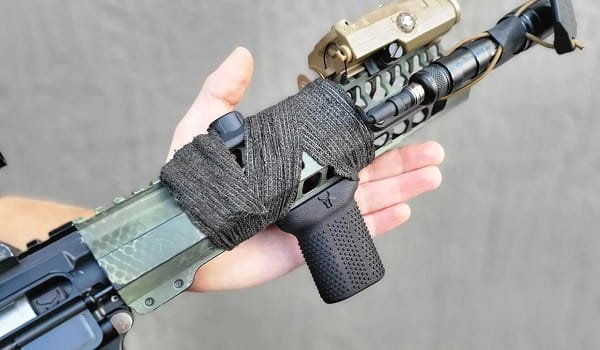
What California Law Bans — Vertical Forward (Pistol-Style) Grips
Under California Penal Code § 30515, a “forward pistol grip” is explicitly one of the features that turns a semiautomatic, centerfire rifle with a detachable magazine into a banned assault weapon.
That means if a rifle has a vertical foregrip (or any grip that allows a “pistol-style grasp” forward of the trigger), it fails the feature test and becomes an illegal assault weapon (unless grandfathered under very narrow older rules — which for most rifles is no longer possible under modern law).
Because a vertical grip is one of several “banned features,” its presence alone (on a rifle with a detachable magazine and other standard traits) is enough to make the weapon unlawful under assault-weapon prohibitions.
Why Angled Foregrips Are Treated Differently
An angled foregrip does not provide the “pistol-style grasp” that the law prohibits. Rather than protruding downward and allowing the hand to hold like a pistol grip forward of the trigger, an angled foregrip gives a more shoot-friendly, ergonomic grip along the barrel/handguard line. Because it doesn’t meet the “forward pistol grip” definition, it is not among the banned features in the statute.
Thus, many California-compliant rifle builders use angled foregrips (or hand-stops) when they must avoid vertical grips, collapsible stocks, flash suppressors, or other features that would render their rifle illegal.
When Angled Foregrips Might Still Be Problematic
Just because an angled foregrip is allowed doesn’t guarantee the whole firearm is legal. If the rifle also has other prohibited features — such as a detachable magazine, pistol grip, flash suppressor, folding stock, or other banned characteristic — the gun can still be categorized as an assault weapon.
Additionally, if modifications transform a handgun into something else (or if the gun’s basic classification doesn’t meet legal definitions), the presence of any grip (vertical or otherwise) may raise separate legal issues under federal or state law (especially when combined with other changes).
Finally, firearm laws in California are complex and enforcement strict. Small configuration details — magazine type, barrel length, muzzle devices, overall length, fixed vs detachable magazine — can alter legality dramatically.
What This Means for Gun Owners in California
- If you have a semi-automatic centerfire rifle and want to install a foregrip, choosing an angled foregrip instead of a vertical grip is a common way to stay within compliance.
- But you must still ensure the rest of the rifle meets California’s “featureless” rules (no flash suppressor, no pistol grip, fixed magazine or CA-compliant mag-lock, etc.).
- Simply having an angled foregrip does not guarantee legality — the full configuration must comply.
- If you are unsure, it’s wise to consult a firearms-law attorney or a licensed dealer familiar with California compliance.
Conclusion
In 2026, angled foregrips are generally legal in California — since state law bans only vertical “forward pistol grips,” not angled grips. However, whether a rifle with an angled foregrip is lawful depends on its entire configuration, including magazine type, stock, muzzle device, and other features. The safe rule is: an angled foregrip itself isn’t banned, but you must make sure the rest of the firearm also meets California’s strict assault-weapon standards.