Few animals symbolize wild California like the California condor.
With wings stretching nearly ten feet across, these massive birds once ruled the skies from coastal cliffs to desert canyons. For thousands of years, they lived quietly alongside humans, feeding on carrion and nesting on remote rock faces.
Then, in barely a century, they almost disappeared.
By the 1980s, only a couple dozen condors were left on Earth.
That collapse wasn’t caused by one mistake. It came from poisoning, habitat loss, human development, slow reproduction, and decades of unintended harm — all piling up faster than the species could recover.
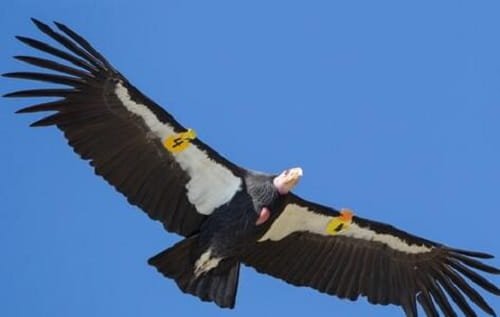
Even today, despite intense conservation efforts, condors remain endangered.
Here’s why.
Lead Poisoning Is the Biggest Killer
This is the main reason condors nearly went extinct — and why they’re still struggling.
Condors are scavengers. They don’t hunt live animals. They eat carcasses.
When hunters use lead ammunition, tiny fragments stay behind in dead animals. Condors ingest that lead while feeding, and even microscopic amounts can be fatal.
Lead poisoning causes:
- Organ failure
- Neurological damage
- Weakness that prevents flying
- Slow, painful deaths
Wildlife biologists regularly have to capture condors and treat them for lead exposure. Without human intervention, many would die.
Even today, lead remains the single greatest threat to their survival.
They Reproduce Extremely Slowly
Condors don’t bounce back quickly.
A breeding pair usually raises just one chick every one or two years. Young birds take many years to mature. That means population growth is painfully slow, even under perfect conditions.
So when adults die from poisoning or accidents, it can take decades to replace them.
Most species can recover from losses.
Condors can’t.
Habitat Loss Shrunk Their Natural Range
As California expanded, condors lost huge portions of their traditional habitat.
Urban growth, highways, power lines, agriculture, and energy development pushed into nesting and feeding areas. Open landscapes became fragmented.
Condors need vast territories to survive.
Modern development chopped those territories into smaller, riskier pieces.
Power Lines and Human Structures Kill Birds
Condors are enormous, heavy birds. Taking off and landing is hard.
That makes them vulnerable to collisions with power lines and towers. Some are electrocuted. Others crash into infrastructure.
Each death hits hard because the population is still so small.
They Nearly Went Extinct in the 1980s
By 1987, the situation was so dire that scientists made a dramatic decision: they captured every remaining wild condor to start a captive breeding program.
At that point, only 27 birds existed worldwide.
It was a last-ditch gamble.
Thankfully, it worked. Zoos and wildlife centers began breeding condors, and over time, birds were released back into the wild.
Today, there are several hundred condors living in California, Arizona, Utah, and Baja California — but most are still closely monitored.
Without that intervention, the species would already be gone.
Trash and Microplastics Create New Problems
Modern life introduced a strange new threat.
Condors sometimes pick up bottle caps, plastic, glass, and other debris while feeding. Adult birds may accidentally carry these items back to nests, where chicks swallow them.
This can cause blockages, malnutrition, or death.
Even survival now comes with 21st-century hazards.
Climate Change Adds Extra Stress
Rising temperatures affect food availability and nesting success. Drought reduces carcass numbers in some regions. Wildfires destroy nesting sites.
Condors already live on the edge.
Climate instability makes everything harder.
They Now Depend on Humans to Survive
Here’s the uncomfortable truth.
California condors are no longer fully wild in the traditional sense.
Most wear tracking devices. Many receive regular health checks. Some are treated for lead poisoning multiple times in their lives. Conservation teams monitor nests and intervene when chicks are at risk.
Without constant human help, populations would decline again.
They’re alive today because people won’t let them vanish.
Why They Matter
Condors play a vital ecological role as natural cleanup crews. They remove dead animals from landscapes, helping prevent disease spread.
But beyond ecology, they represent something deeper.
They’re a living reminder of how quickly human activity can wipe out ancient species — and how hard it is to bring them back.
The Bottom Line
California condors are endangered because lead poisoning from ammunition kills adults, their reproduction is slow, habitat has been heavily reduced, human infrastructure causes fatal accidents, and modern pollution adds new risks.
They nearly went extinct once.
They’re surviving now only through massive conservation effort.
Saving them isn’t about nostalgia.
It’s about proving that humans can take responsibility for damage we’ve caused — and protect what’s left before it’s gone forever.