Yes, DUI checkpoints are legal in California, and police throughout the state continue to use them as one of the primary tools to catch drunk and drug-impaired drivers. Many drivers believe checkpoints violate constitutional rights because officers stop vehicles without individualized suspicion. Others assume you must comply with everything an officer asks at a checkpoint, even beyond legally required questions. The truth sits between these misconceptions. DUI checkpoints are lawful under both California law and U.S. constitutional standards, but they must follow strict rules designed to protect drivers’ rights. Police cannot simply stop cars randomly without following regulated procedures. When checkpoints are set up properly, they are legal; when agencies ignore rules, drivers may challenge their stop in court. Understanding the legality, rules, and rights surrounding checkpoints helps Californians respond correctly on the road.
Why DUI Checkpoints Are Legal in California
The U.S. Supreme Court ruled in Michigan v. Sitz (1990) that DUI checkpoints are constitutional, even though they involve brief, suspicionless stops. California adopted that ruling and enforces checkpoints under state law. Since drunk driving is considered a major public safety threat, courts balance safety against the limited intrusion on drivers. The legal reasoning is that saving lives outweighs the minor inconvenience of being briefly stopped. Because of that ruling, California police departments are authorized to operate checkpoints on major roads, neighborhood streets, and holiday routes without needing individualized probable cause to stop each driver.
Legal Requirements Police Must Follow at DUI Checkpoints
Even though checkpoints are legal, officers must follow strict guidelines to protect motorists’ rights. California courts require that:
- Checkpoint locations must be selected based on public safety and DUI statistics, not officer convenience.
- The checkpoint must use a neutral formula (for example, stop every third car) rather than allowing officers to choose who to stop.
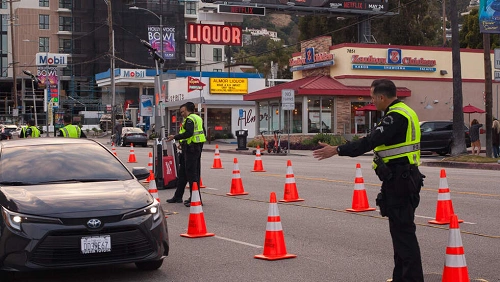
- The site must be clearly identifiable, with proper signage, cones, and visible police presence.
- Supervisors—not field officers—must make operational decisions, including location and stop criteria.
- Delays must be brief, and drivers should only be detained long enough to check for signs of impairment or license violations.
- Public notice should be provided in advance, typically through media postings or police announcements.
If a checkpoint violates these rules, a DUI arrest made there can be challenged in court. Checkpoints are legal only if police operate them legally.
Are Drivers Required to Stop at a Checkpoint?
Yes. If a driver approaches a checkpoint that is clearly marked and operational, they are legally required to stop. However, California drivers are also legally allowed to turn away from a checkpoint before entering it, as long as they commit no traffic violation in the process. Police often patrol surrounding streets to catch people who try to avoid the checkpoint, but avoidance alone does not create reasonable suspicion. Only illegal driving maneuvers—such as an unsafe U-turn, speeding, or running a light—give officers a lawful basis to stop a vehicle.
What Drivers Must Show at a Checkpoint
When an officer asks, a driver must show:
- A valid driver’s license
- Vehicle registration
- Proof of insurance
Failure to provide these documents can result in citations. However, drivers are not required to answer investigative questions such as “Where are you coming from?” or “How much have you had to drink?” California residents may politely decline to answer beyond providing legally required documents. If an officer believes signs of intoxication exist—such as slurred speech, alcohol smell, bloodshot eyes—they may order further investigation.
Can Drivers Refuse Field Sobriety or Breath Tests at a Checkpoint?
A driver can refuse field sobriety tests prior to arrest, and they can legally refuse a preliminary roadside breath test (unless they are under 21 or on DUI probation). However, after a lawful arrest, California’s implied consent law requires drivers to submit to a blood or breath test. Refusing after arrest leads to automatic license suspension and harsher penalties. The key difference is whether a person has been officially arrested.
Do Checkpoints Apply to Cannabis and Other Drugs?
Yes. California enforces driving-under-the-influence laws for alcohol, cannabis, prescription medication, and illegal drugs. Police at checkpoints may test or arrest drivers for impairment even if no alcohol is detected. Specialized officers are trained as Drug Recognition Experts to evaluate signs of drug impairment, and chemical blood tests may follow.
In conclusion, DUI checkpoints are legal in California, but their legality depends on strict procedures designed to protect drivers’ rights. Police may stop cars without individual suspicion, yet they must follow neutral selection rules, provide warning signs, and minimize delays. Drivers must stop when entering a checkpoint and show basic documentation, but they are not required to answer questions that go beyond identification. Those who understand their rights and obligations can navigate checkpoints confidently. California law balances road safety with constitutional protections, making checkpoints lawful when done correctly—and questionable when they are not.